

mockdril-test

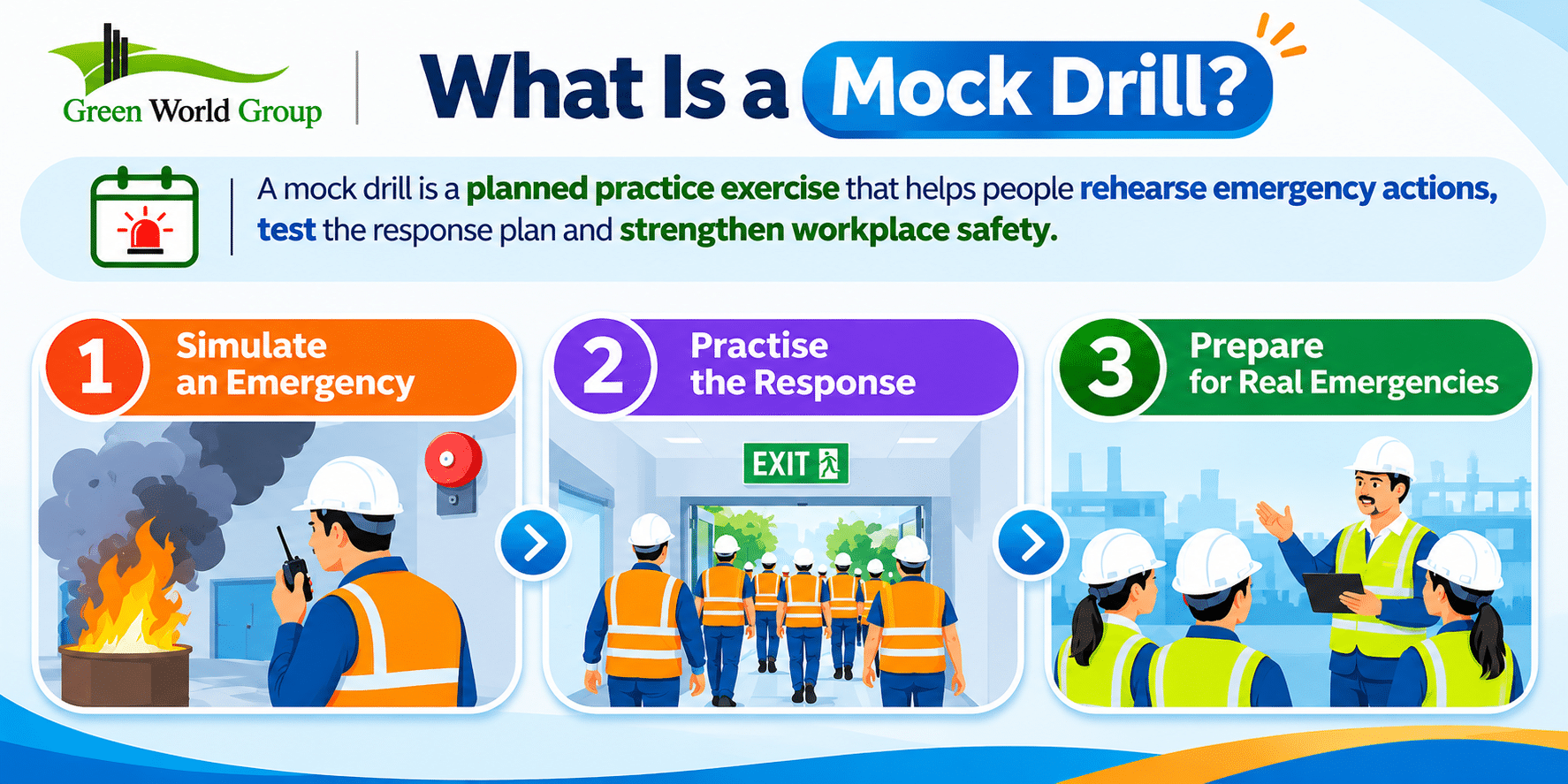
What is a Mock Drill?

⊕ Click or tap to enlarge · Pinch to zoom on mobile

A mock drill is a simulated practice exercise that replicates a real-life emergency or crisis to assess how individuals, employees and emergency response teams react to such situations. It recreates scenarios such as fires, earthquakes, chemical spills and other emergencies in a safe and controlled environment.

Mock drills are commonly conducted in workplaces, factories, schools, hospitals, offices, construction sites and public buildings to provide people with practical experience in following emergency procedures, including evacuation, rescue operations and first aid, so they know how to respond during an actual emergency.
Purpose and Objectives of a Mock Drill

The main purpose of a mock drill is to evaluate an organization's readiness to manage emergencies and determine whether its emergency response arrangements work effectively under realistic conditions. It helps identify areas requiring corrective action, strengthen emergency response capabilities and minimize potential risks to people and property.

OSHA Guidance

According to the Occupational Safety and Health Administration (OSHA), emergency practice drills help workers prepare for emergencies and provide opportunities to evaluate and improve emergency action plans.

⊕ Tap or click to enlarge · Pinch to zoom on mobile

Key Objectives of a Mock Drill

01

Evaluate Emergency Plans

Check how well existing emergency plans work.

02

Assign Roles

Ensure participants understand their individual responsibilities.

03

Validate Communication And Alert Systems

Test communication devices, including alarms, intercoms and emergency notification systems.

04

Measure Evacuation And Response Time

Ensure prompt evacuation by validating quick responses during emergencies.

05

Behavioral Assessment

Monitor the behaviors of people and observe coordination among the team.

06

Identifying Gaps

Spot hidden hazards, such as blocked evacuation routes and system weaknesses, including head count, emergency equipment and procedures.

07

Exercise Emergency Support

Ensure safety by reviewing rescue measures and proper first-aid arrangements.

08

Build Confidence And Awareness

Give practical skills and confidence to tackle emergencies.

09

Foster Safety

Learn lessons from the mock drill, refine systems and strengthen readiness for future emergencies.

Importance of Mock Drills

Knowing emergency procedures is important, but following them under pressure can make a critical difference. Mock drills give people the practice they need to handle unexpected situations with greater confidence.

Why Are Mock Drills Important - 12 Reasons

  1. Emergencies Leave Little Time to Learn: Help people understand what to do in an emergency.
  2. Safety Plans May Have Hidden Weaknesses: Identify gaps in existing emergency plans.
  3. Every Second Matters: Ensure quick evacuation, rescue and medical assistance.
  4. People React Differently Under Pressure: Reduce panic and confusion during emergencies.
  5. Lives and Property Are at Risk: Help prevent injuries and property damage.
  6. Teamwork Matters in Emergencies: Improve communication and coordination among employees.
  7. Emergency Equipment Must Work: Check alarms, communication systems and safety equipment.
  8. Everyone Has Different Needs: Support people who need extra assistance.
  9. Emergencies Can Disrupt Daily Activities: Reduce business interruptions and support faster recovery.
  10. Safety Rules Matter: Follow the safety standards required at work.
  11. Risks Can Change Over Time: Be ready for new hazards as workplace conditions change.
  12. Practice Leads to Better Preparedness: Learn from mistakes and improve emergency response.

Common Types of Mock Drills

Different types of mock drills are conducted based on workplace hazards and potential emergency situations. Some common types include:

  • Fire Mock Drill
  • Emergency Evacuation Drill
  • Earthquake Mock Drill
  • Chemical Spill Mock Drill
  • Gas Leak Mock Drill
  • Medical Emergency Drill
  • Confined Space Rescue Drill
  • Working at Height Rescue Drill
  • Electrical Emergency Drill
  • Industrial Emergency Drill

How to Conduct a Mock Drill: Step-by-Step Procedure

Conducting a mock drill involves planning, preparation, execution, evaluation and corrective action. The following table outlines the general procedure for conducting a workplace mock drill.

Step Procedure Description
1 Identify the Emergency Scenario Select an emergency scenario based on workplace hazard identification and risk assessment (HIRA).
2 Define the Drill Objectives Set objectives to assess -emergency preparedness, response time, communication and procedures.
3 Develop the Mock Drill Plan Define the date, time, location, scope, sequence of events and expected actions.
4 Assign Roles and Responsibilities Appoint a drill coordinator, emergency response team (ERT), safety officers and observers.
5 Arrange Resources and Safety Precautions Check emergency equipment, communication systems, PPE and necessary safety controls.
6 Conduct a Pre-Drill Briefing Explain the drill objectives, assigned duties, emergency procedures and safety instructions.
7 Initiate the Mock Drill Activate the planned emergency signal and begin the simulated incident.
8 Monitor and Record Performance Observe response times, communication, coordination and compliance with procedures.
9 Conclude the Drill Safely Issue the all-clear, conduct a personnel headcount and confirm safe resumption of operations.
10 Conduct a Post-Drill Evaluation Review performance, collect feedback and identify areas requiring improvement.
11 Prepare the Mock Drill Report Document drill activities, observations, findings and recommended corrective actions.
12 Implement Corrective Actions Prepare a corrective action plan (CAP), assign responsibilities and verify improvements.

Mock Drill Example: Fire Mock Drill

Consider a fire mock drill in a manufacturing company and how the procedures are executed in a real-world environment. Here, a fire emergency scenario is simulated. This involves educating employees about how to activate the fire alarms, evacuate safely, gather at designated safe assembly points and account for all employees.

To better understand how a fire mock drill is conducted, watch this video. It covers the entire procedure, from alerting employees through the emergency alarm to completing the evacuation activities.

Watch: Workplace Fire Mock Drill Demonstration

Roles and Responsibilities in a Mock Drill

The roles and responsibilities in a mock drill vary by emergency scenario, workplace hazards, organization size and emergency response plan. Clear responsibilities help ensure safe and coordinated execution.

Roles Responsibilities
Drill Coordinator
Plans, assigns duties and oversees the drill.
Incident Controller
Direct simulated emergency operations, where required.
HSE / Safety Officer
Assesses risks and monitors safety precautions.
Emergency Response Team (ERT)
Performs assigned emergency response activities.
Fire Warden / Fire Marshal
Supports fire safety and evacuation procedures.
First Aider / First Aid Team
Provides first aid and simulated casualty care when needed.
Evacuation Warden / Floor Marshal
Guides occupants and supports evacuation and headcounts.
Communication Officer
Coordinates emergency alerts and information sharing.
Observers / Evaluators
Records response times and evaluates performance.
Employees / Participants
Follow instructions and assigned emergency duties.
Management
Provides resources and oversees corrective actions.

Note: The above-listed positions are recommended for a mock drill, not compulsory roles. Responsibilities can be allotted individually or carried out mutually based on the emergency scenario. Specialised drill types may involve rescue members, security guards or external resources.

Mock Drill Checklist – Before, During and After

A mock drill checklist provides a structured record of essential activities, safety checks and observations throughout an emergency exercise. It enables HSE personnel and evaluators to track completion, document shortcomings and identify necessary improvements.

The following checklist covers pre-drill preparation, drill execution and post-drill review. It can be adapted to suit different workplace hazards, emergency scenarios and organisational requirements.

Workplace Mock Drill Checklist Pre-drill • During drill • Post-drill • Approval View Full Checklist Hide Checklist
WORKPLACE MOCK DRILL CHECKLIST Green World Group | Emergency Preparedness
1 PRE-DRILL INFORMATION AND PREPARATION
No. Checklist Item Details / Record Status Remarks
2 DURING THE MOCK DRILL
No. Checklist Item Details / Record Status Remarks
3 POST-DRILL REVIEW
No. Checklist Item Details / Record Status Remarks
4 OBSERVATIONS AND APPROVAL

How to Evaluate Mock Drill Performance

After completing the mock drill checklist, evaluate the exercise against its planned objectives to identify gaps and improve emergency preparedness.

The following key performance indicators (KPIs) help assess the overall effectiveness of a mock drill.

Evaluation Criteria What to Assess (with Example)
Emergency Response Time
Speed of emergency response, e.g. time taken to begin evacuation after the fire alarm.
Emergency Procedures
Correct use of emergency procedures, e.g. using designated exits instead of lifts.
Personnel Readiness
Understanding of assigned duties, e.g. fire wardens guiding employees to safety.
Communication
Clarity of emergency alerts, e.g. alarms and instructions reaching all work areas.
Team Coordination
Cooperation between response teams, e.g. wardens coordinating with the emergency response team.
Emergency Equipment
Availability and functionality of equipment, e.g. fire alarms and emergency lighting working correctly.
Protective Measures
Safe emergency actions, e.g. employees evacuating to the designated assembly point.
First Aid and Rescue
Effectiveness of emergency assistance, e.g. first aiders attending to a simulated casualty.
Safety Precautions
Safe conduct during the exercise, e.g. avoiding running, pushing or unsafe shortcuts.
Drill Objectives
Achievement of planned goals, e.g. completing evacuation and accounting for all personnel.

Performance Rating: Classify findings as Satisfactory, Needs Improvement or Unsatisfactory against predefined expectations.

The evaluation results help determine whether the drill objectives were achieved and highlight areas requiring further improvement.

Note: Mock drills have no universal passing score or response-time standard. Performance benchmarks should reflect the emergency scenario, workplace risks and predefined objectives.

⊕ Tap or click to enlarge · Pinch to zoom on mobile

Mock Drill Report, Findings and Corrective Actions

⊕ Tap or click to enlarge · Pinch to zoom on mobile

A mock drill report provides documented evidence of the exercise, including observations, performance results and actions needed to strengthen emergency response arrangements. Findings should be based on actual observations rather than assumptions.

Mock Drill Findings Recommended Corrective Actions
Delayed Response Activation
Review alarm escalation and emergency notification arrangements.
Communication Breakdown
Establish reliable communication channels and backup methods.
Deviation from Procedures
Identify procedural gaps and reinforce task-specific instructions.
Unclear Command Structure
Define reporting lines and emergency decision-making authority.
Equipment or Resource Deficiencies
Restore equipment readiness and review resource availability.
Ineffective Risk Controls
Reassess hazards and strengthen relevant safety measures.
Incomplete Response Activities
Review missed actions and address operational constraints.
Competency Gaps
Provide role-specific training and practical competency assessments.

Corrective Action and Follow-Up

Each significant finding should be reviewed to identify its underlying cause, with corrective actions prioritised according to risk. The Corrective Action Plan (CAP) should specify accountable personnel, completion deadlines and verification methods.

After implementing required safety measures and actions, regular inspections and checks are necessary to validate their effectiveness. The learning outcomes of the drills should be included in emergency response plans and safe operating procedures.

01
Review Findings

Identify underlying causes and prioritise corrective actions according to risk.

02
Implement Corrective Actions

Assign accountable personnel, set completion deadlines and implement the required safety measures.

03
Verify Effectiveness

Conduct inspections and checks, verify improvements and update emergency response procedures.

Common Mistakes to Avoid During Mock Drills

  1. Conducting drills without considering possible workplace emergencies.
  2. Repeating the same drill without changing the situation or conditions.
  3. Rushing participants to finish instead of following safe procedures.
  4. Giving too many instructions instead of allowing people to respond.
  5. Forgetting to include visitors, contractors and people needing assistance.
  6. Creating unsafe situations or unnecessary panic during the exercise.
  7. Assuming that completing a drill means everyone is ready for a real emergency.

Best Practices for Conducting Effective Mock Drills

  • Conduct workplace risk assessments and safety audits to identify potential emergencies.
  • Provide employees with appropriate safety training and emergency response instructions.
  • Plan regular mock drills to strengthen practical emergency response skills.
  • Include people with disabilities and arrange assistance based on individual needs.
  • Make suitable arrangements for visitors, contractors and others requiring support.
  • Introduce realistic emergency challenges under safe and controlled conditions.
  • Test emergency arrangements across different shifts and working conditions.
  • Ensure observers are posted at designated points to observe participants' activities.
  • Encourage employees to actively share their suggestions and difficulties without fear of blame.
  • Learn from drill execution and incorporate lessons into necessary documents to better prepare people for future crises, if any.
Conclusion

Conducting regular mock drills is essential for an effective emergency response plan of an organization. The success of a mock drill doesn’t rely on conducting it without any flaws. But taking this as an opportunity to recognize the bottlenecks and weaknesses in the existing systems, learn from mistakes and adapt necessary measures before an emergency occurs.

Green World Group supports organizations in strengthening workplace emergency preparedness through professional health and safety training, risk assessments, safety audits and HSE consultancy services. Our approach helps businesses develop workforce competence, improve safety practices and build safer working environments.

          Enquiry Form