



What Are Safety Goggles?
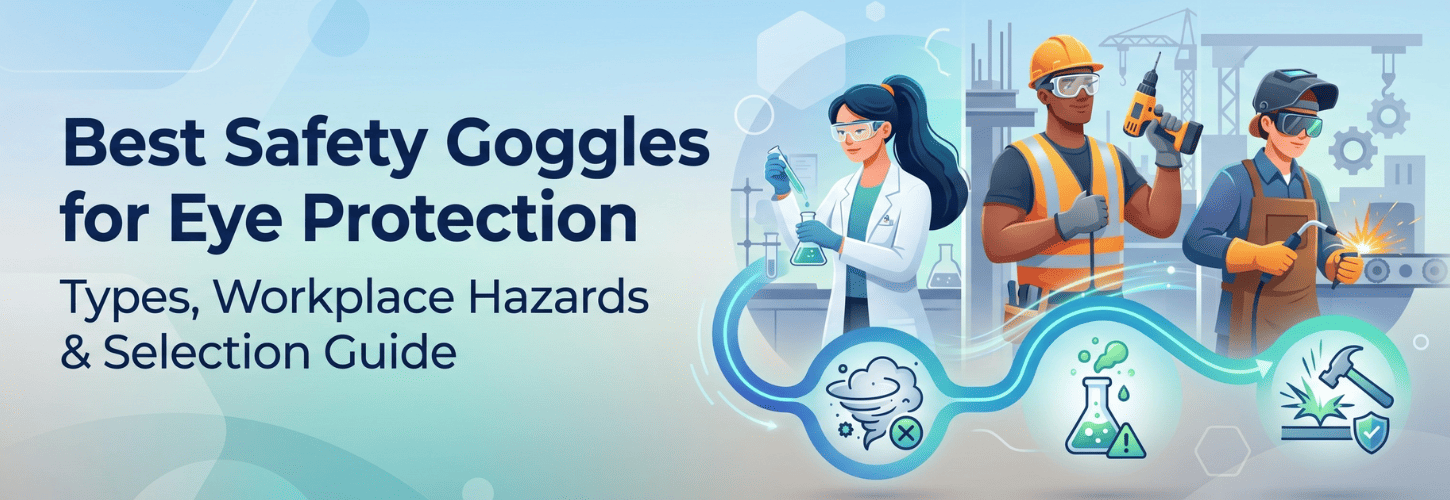
Safety goggles are the protective eyewear that help protect the eyes from workplace hazards such as dust, flying particles, chemical splashes, liquids, fumes, and airborne contaminants. Their enclosed design creates a secure seal around the eyes, while the wraparound frame and adjustable strap provide a comfortable fit and reliable protection by limiting the entry of hazards from multiple directions.
As an important part of Personal Protective Equipment (PPE), safety goggles are widely used in construction, manufacturing, laboratories, healthcare, welding, mining, and chemical industries to help prevent eye injuries and support a safer working environment.
What is the use of Safety Goggles?
When looking for safety goggles, people typically want to find the model that best suits their specific task and working conditions. Therefore, factors such as comfort, durability, impact resistance, ventilation, clear visibility, compliance with relevant safety standards, and compatibility with other types of personal protective equipment may become critical when purchasing safety goggles.
Importance of Safety Goggles in Eye Protection
Eye injuries can happen in a matter of seconds and may result in temporary or even permanent vision loss. Every day, thousands of workers experience eye injuries on the job, yet experts estimate that up to 90% of these incidents are preventable with proper eye protection.
Wearing the right safety goggles,
 Avoid unnecessary eye injuries in the workplace.
- Supports the long-term eye health and well-being of workers.
- Reduce workplace downtime and the costs associated with eye-related incidents.
- Improve worker confidence, productivity, and overall job performance.
- Support compliance with workplace health and safety regulations.
- Promote a stronger workplace safety culture and greater hazard awareness.
 Avoid unnecessary eye injuries in the workplace.
Since eyesight is irreplaceable, safety goggles are one of the most important PPE investments for protecting workers in hazardous environments.
Types of Safety Goggles and Their Uses
Different workplace hazards require different types of eye protection. The design of a safety goggle—especially its ventilation system—determines which hazards it can safely block.
1. Direct-Vent Safety Goggles
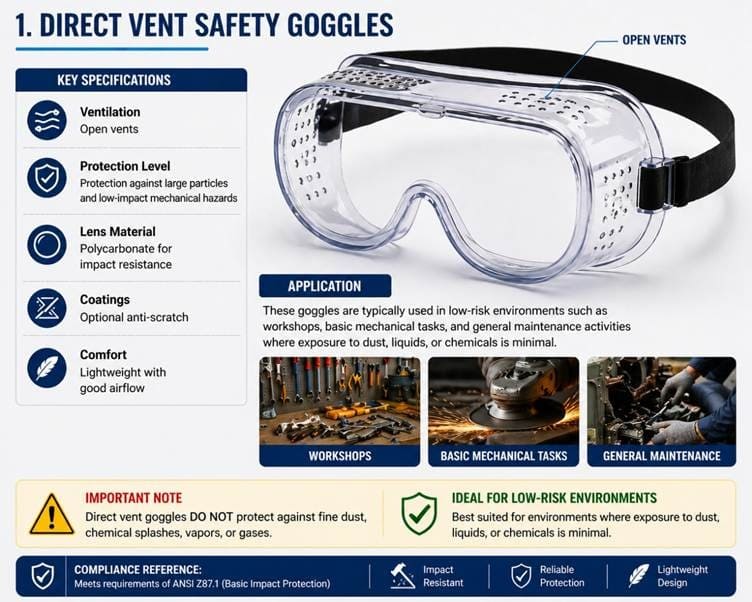
Direct-vent safety goggles feature open ventilation holes or mesh panels that allow continuous airflow, reducing heat buildup, sweat, and lens fogging during use.
It is used in dry work areas where dust, debris, and impact hazards are present. Suitable for tasks such as grinding, cutting, sanding, woodworking, construction, and manufacturing. However, their open vents do not protect against chemical splashes, liquids, fumes, or vapors.
Example:
Grinding Safety Goggles
They feature high airflow, impact resistance and ensure clear visibility without causing fog even when you grind at high friction rates.
Primary Protection: Flying metal sparks, abrasive dust, high-speed fragments, and coarse shattering particles.
Applications & Users: Grinding stations, metal fabrication workshops, machining areas, and cutting zones. Used by machinists, fabricators, and machine operators.
Crtical Safety Note:
These goggles should not be used where liquids, chemicals, or fine hazardous mist are present, as ventilation openings allow direct entry of such substances, leading to severe ocular burns or blindness.
2. Indirect-Vent Safety Goggles
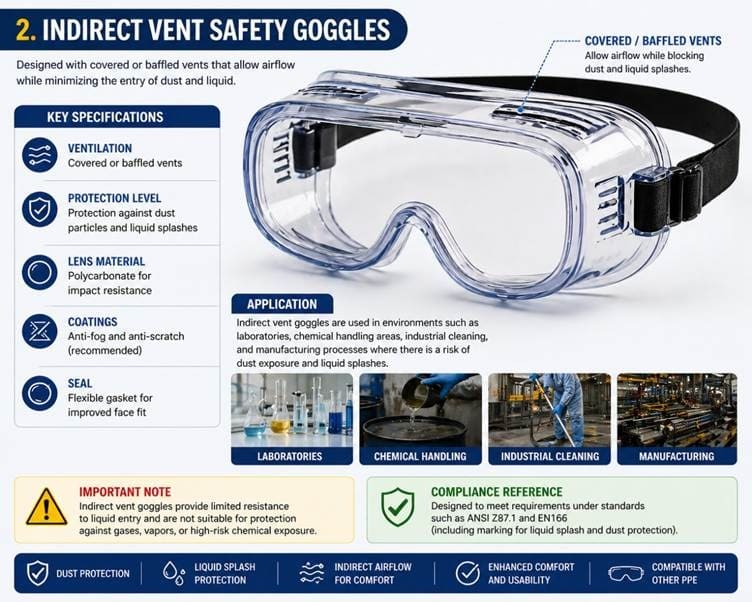
Indirect-vent safety goggles have covered, hooded, or angled ventilation channels. These specialized paths allow continuous air circulation to reduce lens fogging, but create a physical maze that blocks the direct entry of liquids, chemical splashes, and fine particles.
Example:
1.Chemical Safety Goggles
These goggles are designed for workers in high-risk environments that involve handling, mixing, and transferring chemical fluids. They offer maximum protection with a snug-fitting design on the wearer’s face.
- Protect Against: Corrosive liquids, severe chemical splashes, acid spills, and chemical mists.
- Used In: Chemical manufacturing industries, petrochemical processing plants, industrial cleaning operations, and fluid transfer stations.
- Used By: Chemical operators, industrial plant workers, industrial cleaning staff, and hazardous material handlers.
2. Laboratory Safety Goggles
Designed for scientific and research environments where workers handle smaller, diverse volumes of experimental substances and fragile equipment.
- Protect Against: Accidental chemical spills, unexpected minor chemical reactions, flying dust, and sharp, broken glass fragments.
- Used In: School and university science laboratories, independent research centers, quality control testing units, and pharmaceutical labs.
- Used By : Students, researchers, laboratory technicians, and scientists.
3. Medical Safety Goggles
Specialized, fluid-resistant eyewear built for healthcare settings where biological and fluid-borne transmission risks are high.
- Protect Against: Airborne infectious droplets, accidental blood splashes, and dangerous bodily fluids.
- Used In: Hospitals, clinical exam rooms, surgical suites, emergency response units, and diagnostic laboratories.
- Used By : Doctors, nurses, surgeons, and healthcare support staff.
4. Industrial Safety Goggles
Built for everyday, versatile workplace protection in standard industrial environments facing cross-contamination or multi-hazard risks.
- Protect Against: Airborne dust, light liquid splashes, maintenance debris, and small, low-velocity impact particles.
- Used In: Manufacturing factories, assembly lines, repair workshops, and facility maintenance departments.
- Used By : Machine operators, factory workers, assembly technicians, and maintenance personnel
Crtical Safety Note:
These goggles should not be used where liquids, chemicals, or fine hazardous mist are present, as ventilation openings allow direct entry of such substances, leading to severe ocular burns or blindness.
3. Non-Vented / Sealed Safety Goggles
These goggles feature a completely sealed, non-vented frame with no airflow openings. The design creates a tight seal around the eyes to help limit the entry of smoke, gases, vapors, fine particulates, and other airborne contaminants. Because they offer the highest level of environmental protection among safety goggles, they are commonly used in firefighting, hazardous-material response, chemical handling, and other high-risk applications.
Example:
Firefighting Safety Goggles
High-heat resistant, completely sealed goggles engineered to withstand extreme thermal exposure without melting or losing their face seal.
- Protect Against: Creates an impenetrable barrier against choking smoke, extreme radiant heat, blinding steam, and flying airborne ash, soot, or debris.
- Used In: Fire rescue operations, structural firefighting, wildland fire suppression, and emergency disaster response.
- Used By: Firefighters, fire rescue teams, wildland firefighters, emergency responders, industrial fire brigades, and HazMat personnel.
Crtical Safety Note:
The non-vented goggles provide a full seal, and fogging may occur after prolonged use. The goggles must not be raised or removed from your eyes when used in an unsafe area to clear fog, as this compromises your eye safety from hazards.
4. Specialized Filter Lens Safety Goggles
These goggles are defined and selected by their advanced optical lens filtering technology rather than just their frame style. To ensure full protection, they always utilize an indirect-vent or non-vented (sealed) frame.
Example:
Welding Safety Goggles
Welding Goggles: designed to protect the eyes from UV/IR radiation, radiant heat, and flying particles generated during welding and cutting processes.
Types of Welding Safety Goggles by Application
Electric Arc Welding
- Arc Welding Goggles: Protect from excessive glare, ultraviolet and infrared radiation and also prevent arc flash.
- MIG Welding Goggles: Shield eyes from bright arcs, sparks, and splashes from molten metal.
- TIG Welding Goggles: Appropriate for intricate welding operations; safeguard eyes from intense arc light and sparks.
Critical safety Note:
All three kinds of electric arc welding (arc, MIG, and TIG) produce UV radiation. Goggles offer some eye protection, but a welder needs a helmet or face shield for complete face and skin coverage.
Gas Welding & Cutting
- Oxy-Acetylene Goggles: Reduce flame glare and help protect against hot metal splashes.
- Cutting Torch Goggles: Protect against bright flames, radiant heat, and flying slag particles.
Specialized Lens & Fit
Auto Darkening Goggles: Automatically darken upon detection of the welding arc to reduce exposure to intense glare.
Over-the-Glass (OTG) Goggles: Ensure comfortable wear over prescription glasses while providing eye protection.
Environment & Lens Variants
- Tinted Goggles: Widely used for brazing, soldering and light welding.
- Clear Goggles: Best suited for grinding, setup, and inspection work; they do not provide protection from welding arc radiation.
Laser Radiation Safety Goggles
This type of goggles protects your eyes from exposure to hazardous lasers by using special OD filters that block specific laser wavelengths while maintaining clear visibility.
- Protect against: Prevents permanent retinal damage and blindness from direct, scattered, or reflected laser beams.
- Where it is Used: Medical laser surgeries, industrial laser work, telecommunications testing, and research labs.
- Who uses: Surgeons, medical laser technicians, laboratory researchers, industrial laser operators, telecommunications engineers, and scientific personnel working with laser systems.
Critical Safety Note
Laser goggles are strictly wavelength-specific. A goggle engineered for an Infrared laser (e.g., CO2 or Nd:YAG) offers zero protection against a Blue or Green visible light laser. Mixing up laser eyewear will lead to instantaneous, catastrophic, and permanent blindness. Always match the laser’s exact nanometer (nm) output to the printed specification on the goggle frame.
Gas Cutting Safety Goggles
Shaded eyewear (typically featuring shade 3 to 5 lenses) designed specifically to handle high-temperature, gas-fueled flame operations.
- Use: Oxy-fuel cutting, torch brazing, flame soldering, and high-heat metal cutting work.
- Protection: Safeguards against intense torch flame glare, high radiant heat, flying molten slag, and metal particles.
Comparison of Safety Goggles with Other Eye Protection Types:
Safety goggles and safety glasses both protect the eyes from workplace hazards, but they differ in coverage and protection levels. The table below highlights their key differences between Safety Goggles Vs Safety Glasses
| Feature | Safety Goggles | Safety Glasses |
|---|---|---|
| Design | Fully enclosed, sealed fit | Open design similar to regular spectacles |
| Coverage | Complete eye coverage | Front eye protection only |
| Protection | Protects against dust, chemical splashes, vapors and debris | Protects against flying particles and impact hazards |
| Protection Level | High | Basic to Moderate |
| Use Environment | Laboratories, chemical handling, dusty and high-risk work areas | Construction, manufacturing, workshops, and general industrial tasks |
| Comfort | Moderate due to secure fit | High due to lightweight design |
| Ventilation | Available with direct or indirect vents | Naturally ventilated open design |
| PPE Compatibility | Compatible with respirators, face shields, and helmets | Compatible with most workplace PPE |
How to choose the Right Safety Goggles for Eye Protection
When selecting safety goggles:
- Always identify hazards such as dust, chemicals, impact, heat, gases, or splashes —before selecting goggles.
- Choose goggles with proper sealing (spill-proof / splash-proof design) to prevent liquid or chemical entry.
- Go for dust-proof goggles with a secure, tight fit to keep out fine particles.
- Make sure the goggles are impact-resistant when there’s a risk from flying debris or fragments.
- Use heat- and radiation-resistant (welding) goggles when working in high-temperature areas or in areas with UV/IR exposure.
- For gases and fumes, choose fully sealed (non-vented) goggles for complete protection.
- Check the vent type (direct, indirect, non-vented) based on the level of risk and exposure.
- Prefer lenses made of polycarbonate for high durability and impact resistance
- Look for anti-fog and scratch-resistant coatings for clear and long-lasting vision
- Select the right lens type, whether clear, tinted, or filtered, for the task at hand.
- Make sure the goggles fit comfortably and securely, with no gaps.
- Check that they are compatible with other PPE, such as helmets, respirators, and face shields.
Industrial Safety Goggle Standards and Compliance Requirements
When selecting safety goggles, it is important to check certification markings. These indicate the level of protection provided against specific workplace hazards.
ANSI Z87.1 (United States)
The ANSI Z87.1 standard defines performance requirements for occupational eye and face protection.
- Z87 → Indicates basic impact protection (meets minimum requirements for safety eyewear).
- Z87+ → indicates enhanced protection against high-velocity impact from flying particles/debris
- Manufacturer markings → Identify the manufacturer for traceability and compliance verification.
- Lens markings → for additional protection against UV rays, anti-fogging, and/or scratch resistance (based on lens type/model)
EN 166 (Europe)
EN 166 is the European standard for personal eye protection. Where the SafetyGoggles are marked with codes that indicate resistance to specific hazards:
- 3 → Protection against liquid droplets and splashes
- 4 → Protection against large dust particles
- 5 → Protection against gas and fine dust particles (varies by design and sealing level)
- 8 → Protection against short-circuit electric arc
- 9 → Protection against molten metals and hot solids
Best all-in-one Purpose Safety Googles
Indirect-vented polycarbonate safety goggles are widely regarded as the best all-purpose safety goggles for industrial environments because they provide a balance of splash protection, impact resistance, comfort, and visibility.
Impact of Not Wearing Safety Goggles
- Eye injuries are caused by flying particles, dust, or metal fragments.
- Chemical exposure that may continue to damage the eyes even after initial contact.
- Photokeratitis (“welder’s flash”) resulting from UV exposure during welding or cutting.
- Eye irritation from repeated exposure to dust, fumes, and airborne particles.
- Temporary vision impairment can increase the risk of workplace accidents.
- Reduced depth perception, making it more difficult to operate tools and machinery safely.
- Lost work time, restricted duties, or medical treatment following an eye-related incident.
- Safety compliance issues that may lead to fines, failed audits, or insurance complications.
Even minor exposure can lead to long recovery time and long-term vision complications.
Conclusion
Safety goggles are a key part of protecting your eyes from workplace hazards, but simply wearing them isn’t enough—the type you choose needs to match the risk and the job. When you understand the difference between vented designs and select goggles based on the specific hazard, the level of protection improves significantly.
At the same time, proper PPE training ensures goggles are used correctly and that workers are aware of the risks around them. Green World Group supports this by offering practical PPE training that helps build real safety skills and promotes safer work environments.